
आओ करें देश तैयार, शुद्ध वायु सबका अधिकार · Clean air is everyone's right

Air pollution kills 7.9 million people a year.

That is about one death every four seconds, mostly from fine particles too small to see. ShudhVayu's patented roof filter turns every car into an air purifier.
  • Developed with IIT Delhi
  • Funded by DST, Govt. of India
  • Patented
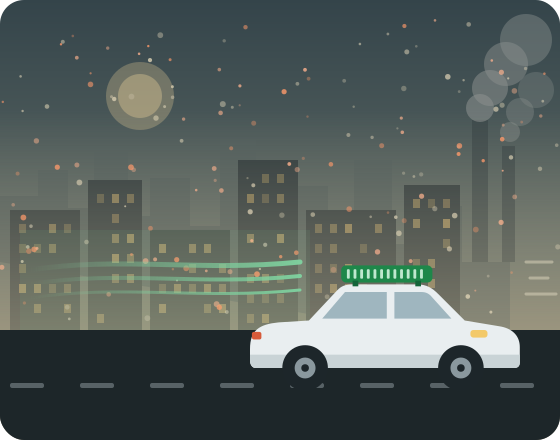
A city under smog. A car with a ShudhVayu filter on its roof leaves a trail of cleaner air.
Our innovation

Every car can clean the air it drives through

The ShudhVayu filter sits on the roof and uses the wind from driving to pull fine particles out of the air. No power, no wiring, no running cost.
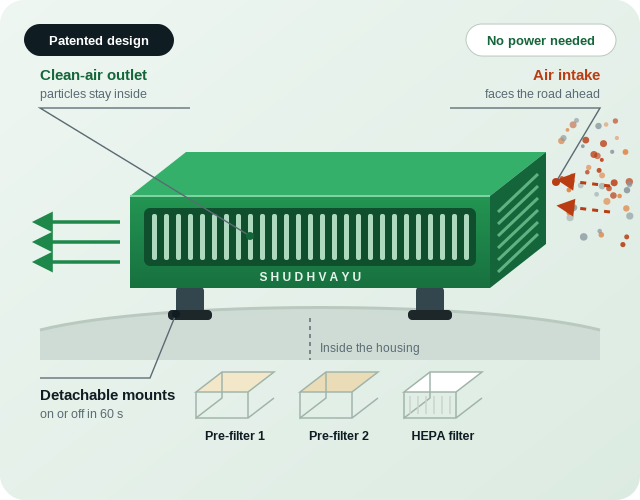
The ShudhVayu roof filter: polluted air enters the intake facing the road, passes through two pre-filters and a HEPA filter, and cleaner air leaves through the outlet. Detachable mounts, patented design, no power needed.
  1. 1
    Clip it onDetachable mounts. On or off in under 60 seconds.
  2. 2
    Drive as usualThe road wind pushes outside air through the filter.
  3. 3
    Particles stay behindTwo pre-filters and a HEPA core trap fine dust and smoke.
On-road demo at 50 km/h
450→≈0
PM2.5 reading of the air before and after the filter, in ShudhVayu's own demonstration.
Filters for hatchbacks, sedans and SUVs

From ₹7,999 ₹12,999

IIT DelhiDeveloped in an R&D project with IIT Delhi
DST, Govt. of IndiaFunded by the Department of Science and Technology
PatentedShudhVayu's own filter technology
Zero energyNo battery, no wiring, no running cost
The global toll

The world's biggest environmental killer

Air pollution is the leading environmental risk factor for death worldwide. These are the latest global estimates.

7.9 million

deaths were linked to air pollution in 2023, making it the leading environmental cause of death worldwide.

That is about 21,600 deaths every day.

State of Global Air 2025 [1]
86%

of those deaths came from long-term illnesses such as heart disease, stroke, diabetes, cancer and COPD.

6.8 million deaths, 2023 [1]
709,000

children under five died from air pollution in 2021: 15% of all deaths at that age.

State of Global Air 2024 [2]
89%

of deaths from outdoor air pollution happen in low- and middle-income countries.

WHO, 2019 data [3]
36%

of the world's people live where fine particles exceed even the WHO's least strict target of 35 µg/m³.

State of Global Air 2025 [1]
900

people die from air pollution every hour

7.9 million deaths a year, divided by the 8,766 hours in a year. [1]

= 10 people

Deaths by type of air pollution, 2023

Fine particles in outdoor air are the largest cause. [1]

  • Outdoor fine particlesPM2.5 from traffic, industry, burning4.9 million
  • Household air pollutionCooking and heating with solid fuels2.8 million
  • OzoneFormed from vehicle and industrial gases470,000

Some deaths are linked to more than one type, so the three add up to more than the 7.9 million total.

How outdoor air pollution kills

Causes of the 4.2 million deaths from outdoor air pollution in 2019. [3]

  • 68%Heart disease and stroke
  • 14%Chronic obstructive pulmonary disease (COPD)
  • 14%Acute lower respiratory infections
  • 4%Lung cancer
Your health

It harms far more than your lungs

Polluted air damages the heart, the brain and the blood vessels as well as the lungs. Children, older people and anyone with an existing illness are hit hardest.

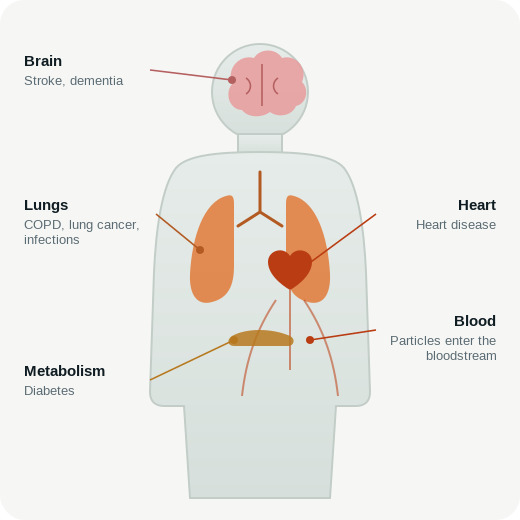
Body diagram: air pollution is linked to stroke and dementia in the brain, COPD, lung cancer and infections in the lungs, heart disease, particles entering the bloodstream, and diabetes.
1 in 2

chronic respiratory disease deaths are caused by air pollution.

Worldwide, 2023 [1]
1 in 4

heart disease deaths are caused by air pollution.

Worldwide, 2023 [1]
625,000

dementia deaths were linked to air pollution, counted for the first time.

Worldwide, 2023 [1]
Fine particles

The killer you cannot see

PM2.5 means particles 2.5 micrometres across or smaller. A human hair is about 70 micrometres wide, 30 times larger than the largest fine particle. [8]

  1. Breathed in

    Particles smaller than 10 micrometres (PM10) can get deep into your lungs. [8]

  2. Deep in the lungs

    Fine particles (PM2.5) travel furthest and are linked to heart disease, stroke, COPD and lung cancer. [3]

  3. Into the blood

    Some particles can even get into your bloodstream [8], which is how the harm reaches the heart and the brain.

Drawn to scale. Sizes are diameters in micrometres (µm); 1 µm is a thousandth of a millimetre. [8]

Where fine particles come from

  • Vehicles
  • Power plants
  • Factories
  • Cooking and heating fuels
  • Farming
  • Waste and crop burning
  • Wildfires

Source: State of Global Air 2025 [1]

वायु प्रदूषण का सबसे घातक हथियार अदृश्य ज़हरीले कण हैं। The deadliest weapon of air pollution is invisible, poisonous particles.

Years of life

Polluted air shortens every life it touches

The Air Quality Life Index turns pollution levels into years of life expectancy. If the whole world met the WHO guideline for fine particles, the average person would live 1.9 years longer. [5]

1.9 years

of life lost by the average person on Earth.

2023 data [5]
3.5 years

of life lost by the average person in India.

2023 data [5]
8.2 years

of life lost by the average person in Delhi: the highest anywhere in the world.

2023 data [5] [6]

Fine particles take more life than…

How many times more years of life fine particles cost worldwide than each of these threats. Only smoking comes close. [5]

  • Tobacco useabout the same
  • Child and maternal malnutrition1.4×
  • High alcohol use4.4×
  • Road and transport injuries4.6×
  • Unsafe water and sanitation4.6×
  • HIV/AIDS6.7×

Ratios published in the AQLI 2025 annual update, based on global average life expectancy in 2023. Fine particles cost the average person 1.9 years of life.

How far above the safe level?

Average fine-particle (PM2.5) level in 2023, micrograms per cubic metre of air. [4] [5] [6]

  • WHO guidelineThe level WHO considers safe5
  • World average≈5× the guideline24.1
  • India national standardIndia's own legal limit40
  • India average8× the guideline41
  • Delhi average18× the guideline88.4

Annual averages. The WHO also sets a 24-hour limit of 15 µg/m³. [4]

India

India carries one of the heaviest burdens

About 2 million people in India died from air pollution-related diseases in 2023, up 43% from 1.4 million in 2000. [7] Every person in India lives where fine-particle levels exceed the WHO guideline. [5]

7 in 10

COPD deaths in India are caused by air pollution.

2023 [7]
1 in 3

lung cancer deaths in India are caused by air pollution.

2023 [7]
1 in 4+

heart disease deaths in India, and nearly 1 in 5 diabetes deaths, are caused by air pollution.

2023 [7]
46%

of Indians live where fine particles exceed even India's own national standard of 40 µg/m³.

2023 [5]
Choose your filter

Fit a filter. Clean your city's air.

Every filter on the road cleans the air for everyone around it. Pick the size for your car.

Secure payment by Razorpay. Delivery in 3–7 business days.

The innovation

Amit Bhatnagar explains the filter.

On the road

The PM2.5 reading behind the filter at 50 km/h.

Under a minute

Fitting and removing the filter against the clock.

YouTube videos load only when you press play. Nothing plays by itself.

Join the mission

Clean air is everyone's right

Governments cannot fix the air alone. Here is how you can help ShudhVayu clean the air in your city.

Fit a filter

Turn your hatchback, sedan or SUV into an air purifier.

See prices →

Become a Samarthak

Sponsor a filter for a vehicle in your city.

Sponsor a filter →

Become a Rakshak

Register your vehicle to carry a ShudhVayu filter.

Register →

Support a health camp

Help us run free health and awareness camps.

About the camps →

Ready to help?

Tell us how you would like to take part. We reply on WhatsApp, around the clock.

Sources

Figures are the latest published estimates as of November 2026. Each number on this page links to its source.

  1. Health Effects Institute. State of Global Air 2025, with IHME and the NCD Alliance; data for 2023. Released 23 October 2025.
  2. Health Effects Institute. State of Global Air 2024, with UNICEF; data for 2021.
  3. World Health Organization. Ambient (outdoor) air quality and health, fact sheet, 24 October 2024; data for 2019.
  4. World Health Organization. WHO global air quality guidelines, 2021: PM2.5 annual mean 5 µg/m³, 24-hour mean 15 µg/m³.
  5. Energy Policy Institute at the University of Chicago (EPIC). Air Quality Life Index, 2025 annual update; data for 2023. August 2025.
  6. EPIC India. Delhi residents losing 8.2 years of their lives to high air pollution, 28 August 2025.
  7. Down To Earth. Air pollution damaging brain health, worsening disease burden in India: SoGA 2025, reporting India figures from State of Global Air 2025.
  8. US Environmental Protection Agency. Particulate Matter (PM) Basics.

The live counter at the top of the page divides 7.9 million deaths a year by the seconds in a year (about one death every four seconds). It is an average, not a live measurement.